
For a trade professional, branding isn't about pretending to be a bigger business than you are, nor is it simply about having a smart logo. Good branding is about giving customers confidence that they're dealing with someone who takes their work, their business and ultimately their customer seriously.
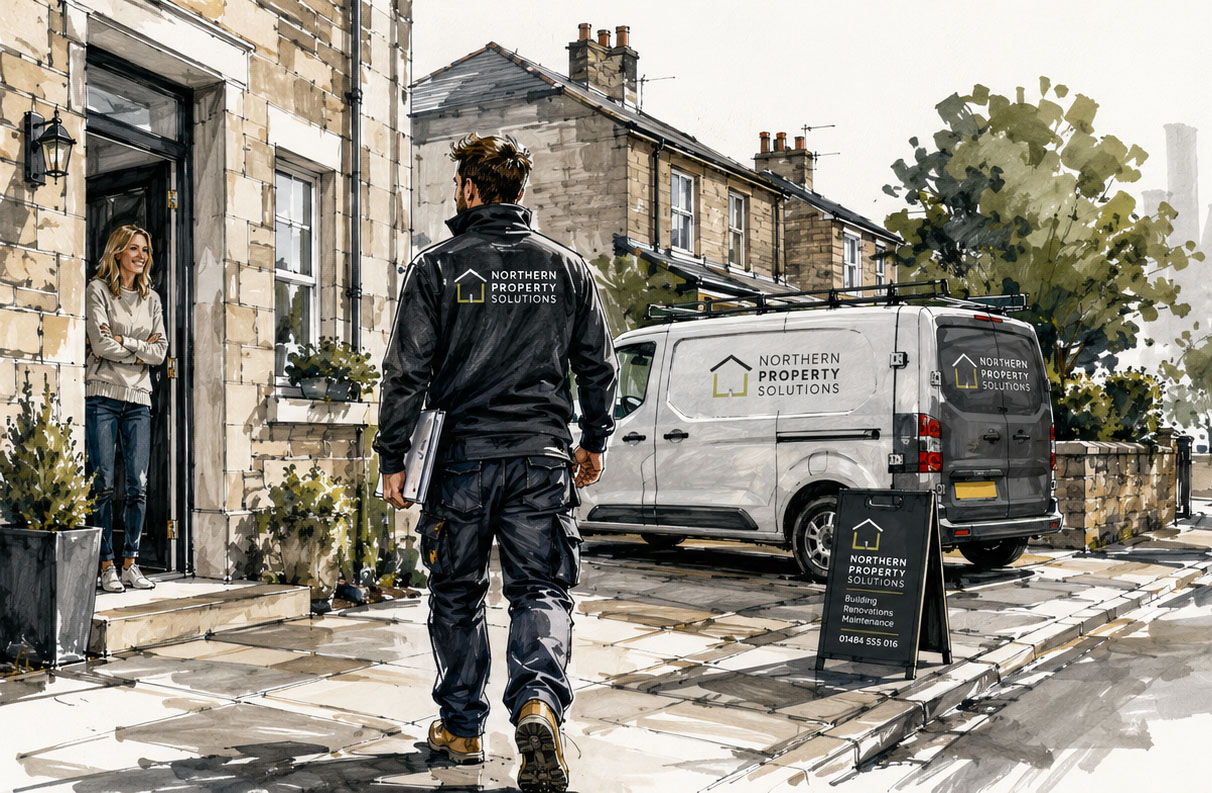
Think about the experience from the customer's point of view. They might first come across you through a recommendation or something they've seen on social media. A few days later your van arrives outside their house, you knock on the door wearing branded workwear and, while you're working, your pavement sign sits outside the property. Once the job is complete, you leave them with the appropriate paperwork and perhaps something they can easily pass to somebody else who asks who did the work.
None of those things is particularly complicated, but together they create an impression of the business behind the work. Each one can either reinforce the customer's confidence or chip away at it.
Workwear – looking ready for the job
Your workwear is one of the first things a customer notices when you arrive. It doesn't need to be pristine — you're there to work, after all — but appropriate, properly branded workwear immediately identifies who you are and which business you're representing.
There's also an important difference between looking like you've been working hard and simply looking scruffy. Good trade workwear has a job to do. It needs to be comfortable, practical enough for the work, capable of surviving repeated washing and still present your business properly when you arrive at the next customer's door.
This is also why choosing workwear purely on the cheapest garment price can be false economy. If something loses its shape, fades or needs replacing twice as often, it wasn't particularly cheap in the first place. More importantly, what you're wearing is contributing to the customer's first impression before you've even picked up a tool.
Pavement signage – don't keep good work a secret
If you're already working on site, people are already walking or driving past. A simple pavement sign outside the property can identify who's carrying out the work and turn a job you're already doing into useful local visibility.
For trades, this can be particularly effective because people aren't just seeing an advert; they're seeing the evidence behind it. A neighbour can see the extension being built, the kitchen going in, the windows being replaced or the property being decorated. Your name sitting alongside that work starts to connect the two.
It also creates familiarity. When that neighbour needs similar work six months later, your business isn't completely unknown to them. They've seen the name before and, more importantly, they've seen you doing the work.
Sign-off documentation – the job doesn't finish when the tools are packed away
Professionalism shouldn't disappear at the point the physical work is complete. Quotes, completion documents, guarantees, inspection sheets, care instructions and other handover information are all part of the customer's experience of dealing with your business.
They don't need to be over-designed or unnecessarily complicated. They do need to be clear, properly presented and recognisably yours. Good documentation gives the customer something useful to retain and demonstrates that there's a proper business and a process sitting behind the workmanship.
It matters later, too. If a customer needs to find a guarantee, check a specification or contact you again in two years' time, a clearly branded document makes that considerably easier than trying to remember who did the job and searching through old messages on their phone.
Referral cards – make it easy for people to recommend you
Good tradespeople have always built businesses through recommendations, but we sometimes make the customer work unnecessarily hard to give one.
Someone asks who fitted their kitchen, decorated the house or did the electrical work and the response becomes, "It was a bloke called Dave — hang on, I'll see if I can find his number." That's hardly the strongest introduction to a business.
A simple referral card gives a satisfied customer something they can actually pass on. It might contain your contact details, website and social channels, or simply a QR code taking someone straight to the right place.
You're not trying to turn customers into unpaid salespeople. You're just making it easier for someone who is already happy with your work to tell somebody else about you. A recommendation already carries trust; good branding simply makes sure the next person can easily find the business being recommended.
Vehicle branding – put the van to work as well
For many trades, the van is one of the largest and most visible pieces of marketing the business owns. It's outside customers' homes, parked on jobs and travelling around the local area throughout the working week, so leaving it completely anonymous is a missed opportunity.
That doesn't mean every van needs to be covered from bumper to bumper in graphics. Clear, well-designed vehicle branding that tells people who you are, what you do and how to find you can often do the job perfectly well.
There's another, subtler benefit. When a customer has booked a company and a clearly branded van arrives outside their home, it provides another small piece of reassurance that the person walking towards their front door is exactly who they're expecting.
Social content – show people how you actually work
Social media is where all of these elements can start working together. Rather than an endless succession of posts saying "Here's another job we've done", it gives you the opportunity to show prospective customers what dealing with your business actually looks like.
Show the team working in proper workwear. Let the pavement signage appear naturally in photographs from site. Show the van, the work in progress and the finished result. Talk about how the job was approached and, where appropriate, show what happens at handover.
You're then doing something far more useful than repeatedly telling people you're professional. You're providing evidence of it.
A prospective customer who has followed your business for a while can already have a reasonable idea of who will turn up, how you present yourselves, the standard of work you produce and how you operate before they've even made an enquiry.
Making it all work together
None of this needs to be extravagant and it certainly doesn't mean covering everything you own with the biggest possible version of your logo. Consistency is considerably more important.
The identity on the workwear should match the van. The pavement signage should look like it belongs to the same business as the paperwork. A referral card should take somebody to a website or social presence that continues the same impression.
That's when branding starts doing its proper job. It helps people recognise you, remember you and understand what sort of business they're dealing with.
For trade professionals there's another consideration that's arguably even more important. You're often asking someone to trust you with their home, premises or a significant amount of their money. Long before they can judge the quality of the finished work, they're looking for smaller signals that tell them they've made the right choice.
Good branding is one of those signals.
At Apparel Monkey, we see branded workwear as part of that bigger picture: helping businesses look as professional as the work they do.